Correction and Retraction
ESCALATE | PUBLICATION ETHICS
Correction &
Retraction Policy.
A transparent and responsible editorial framework for correcting published research, addressing unreliable findings, managing publication integrity concerns, and preserving the accuracy and credibility of the scholarly record.
CORRECTIONS RETRACTIONS COPE-ALIGNED PRINCIPLES
04
EDITORIAL ACTIONS
COPE
ETHICAL GUIDANCE
2025
RETRACTION GUIDELINES
Escalate: Economics and Business Journal is committed to maintaining the accuracy, reliability, transparency, and integrity of its published scholarly record. The journal recognizes that errors, omissions, methodological concerns, or ethical irregularities may occasionally be identified after an article has been published.
When such concerns arise, the Editorial Team is responsible for evaluating the available evidence and determining an appropriate editorial response. Depending on the nature and seriousness of the issue, corrective action may involve a formal correction, an Expression of Concern, a retraction, or another appropriate editorial notice.
This policy is informed by internationally recognized scholarly publishing principles, particularly the Committee on Publication Ethics (COPE) Retraction Guidelines, updated in August 2025, and relevant best practices concerning the preservation and transparency of the scholarly record.
ⓘ Fundamental Editorial Principle
The primary purpose of correction and retraction is to preserve the reliability and integrity of scholarly literature, not to punish authors. Editorial actions must be based on appropriate evidence, procedural fairness, transparency, and an objective assessment of the validity of published findings. Honest errors and substantiated misconduct must be distinguished wherever the available evidence permits.
EXPLORE THIS POLICY
01 / EDITORIAL RESPONSIBILITY
Purpose and Scope of the Policy
Maintaining an accurate, transparent, and trustworthy scholarly record.
Escalate: Economics and Business Journal recognizes its responsibility to ensure that published scholarly content remains accurate, reliable, and appropriately documented. Post-publication corrections and retractions form an essential part of the self-correcting nature of scholarly communication.
The policy applies to published research articles, review articles, case study articles, methodological articles, and other scholarly content officially disseminated by the journal.
Concerns may be raised by authors, editors, reviewers, readers, research institutions, publishers, or other individuals who identify potential errors or integrity problems in published materials.
The Editorial Team evaluates each concern according to its nature, available evidence, potential effects on the validity of the publication, and applicable scholarly publishing standards.
02 / CORRECTION POLICY
Correction of Published Articles
Rectifying errors while preserving valid scholarly findings.
EDITORIAL ACTION / CORRECTION
What Is a Correction?
A Correction is a formal editorial notice intended to amend an error, omission, or inaccurate statement in a published article when the problem can be resolved without invalidating the article's principal findings and conclusions.
Corrections may be initiated by authors, editors, readers, or other parties and are subject to editorial verification. The original article ordinarily remains available, with appropriate documentation and links to the correction notice where the change is editorially significant.
A. Minor Corrections
Minor corrections concern typographical, formatting, bibliographic, or production errors that do not materially alter the scholarly findings or interpretation of the research.
✓ Typographical or grammatical errors.
✓ Incorrect author affiliations or institutional details.
✓ Errors in article metadata or bibliographic information.
✓ Inaccuracies in acknowledgments or funding information.
✓ Formatting problems that do not change the scientific meaning.
The Editorial Team determines whether a minor correction requires a separate formal notice or may be addressed through a documented technical update, taking into account its significance for interpretation, attribution, and indexing.
B. Substantive Corrections
Substantive corrections address errors that affect readers' understanding of specific aspects of the research but do not undermine the overall reliability of its principal findings.
✓ Errors in statistical calculations that do not invalidate the principal conclusions.
✓ Incorrect numerical values in tables or figures.
✓ Omitted methodological details necessary for accurate interpretation.
✓ Incorrect descriptions of results or specific analytical procedures.
✓ Necessary clarifications concerning limitations or interpretations.
Publication of Correction Notices
A formal correction notice should clearly identify the original article, describe the error, explain the correction, and state whether the findings or conclusions are affected.
Where appropriate, the notice should be freely accessible and linked to the original publication. Significant updates should be reflected consistently in the journal website, downloadable files, and relevant publication metadata.
03 / RETRACTION POLICY
Retraction of Published Articles
Formal action when published findings or conclusions are no longer sufficiently reliable.
EDITORIAL ACTION / RETRACTION
What Is a Retraction?
A Retraction is a formal editorial action that alerts readers when a published article contains serious problems that compromise the reliability of its findings or conclusions, or when significant publication ethics violations justify withdrawal of confidence in the publication.
Retraction does not ordinarily involve deleting the article from the scholarly record. Instead, the article should remain identifiable, clearly marked as retracted, and connected to an explanatory retraction notice. The decision may be appropriate whether the underlying problem results from serious honest error or research misconduct.
Grounds for Considering Retraction
01. Unreliable Research Findings
Clear evidence demonstrates that the article's principal findings or conclusions are unreliable because of fundamental methodological errors, inaccurate analyses, data irregularities, or other serious problems.
02. Data Fabrication or Falsification
Evidence establishes that research data, observations, analyses, or results were fabricated, falsified, or materially manipulated in a manner that undermines the trustworthiness of the article.
03. Serious Plagiarism
The publication contains substantial unauthorized or unattributed use of another person's intellectual contributions, text, data, or other scholarly material that warrants retraction rather than a limited correction.
04. Duplicate or Redundant Publication
The article substantially duplicates previously published findings without appropriate acknowledgment, cross-referencing, permission, or sufficient scholarly justification.
05. Serious Research Ethics Violations
The research involves significant ethical irregularities, including misrepresentation of required ethical approvals, unauthorized use of confidential data, or serious violations affecting research participants or the integrity of the investigation.
06. Manipulated Peer Review
The article was accepted or published through a seriously compromised peer-review process involving fabricated reviewer identities, fraudulent reviews, or other substantial manipulation affecting editorial integrity.
07. Other Serious Publication Irregularities
Other substantiated problems, including unauthorized use of research materials, significant misrepresentation, or undisclosed interests that compromise confidence in the publication, may justify retraction following appropriate editorial assessment.
Retraction Is Not an Automatic Penalty
Not every error, authorship dispute, similarity finding, or undisclosed competing interest warrants retraction. The Editorial Team must consider the significance of the problem, the reliability of the research findings, available supporting evidence, and whether a correction or another editorial action would be sufficient.
Information Required in a Retraction Notice
01. Full title of the retracted article.
02. Authors and complete bibliographic identification, including DOI where available.
03. Clear and factual reasons for the retraction.
04. Identification of the individual or body issuing the retraction.
05. Date of the retraction notice.
06. Relevant information concerning the authors' agreement or disagreement, where appropriate.
07. A visible link to the original article and an indication of its retracted status.
04 / EXPRESSION OF CONCERN
Expressions of Concern
Informing readers about unresolved questions affecting published research.
An Expression of Concern is a formal editorial notice used when credible and potentially serious questions have arisen regarding a published article, but the available evidence is insufficient to justify a definitive correction or retraction.
The notice is intended to alert readers to unresolved concerns while allowing appropriate evaluation, clarification, or investigation to continue.
Circumstances That May Warrant an Expression of Concern
✓ Serious questions concerning research data or results remain unresolved.
✓ Evidence of possible misconduct is credible but inconclusive.
✓ A relevant institutional investigation is ongoing.
✓ Significant concerns cannot be resolved promptly because essential evidence is unavailable.
✓ There are substantial reasons to alert readers before a final editorial determination becomes possible.
The publication of an Expression of Concern does not constitute a finding of misconduct. When further evidence becomes available, the journal may update the notice, issue a correction or retraction, or clarify that the concerns have been resolved.
05 / PRE-PUBLICATION WITHDRAWAL
Manuscript Withdrawal Before Publication
Distinguishing unpublished manuscript withdrawal from published article retraction.
Manuscript Withdrawal refers to the discontinuation of editorial consideration of a manuscript before it has been published. Withdrawal differs from retraction because a withdrawn manuscript has not entered the journal's published scholarly record.
Authors who wish to withdraw a manuscript should submit a formal written request to the Editorial Office, explaining the reasons for withdrawal and identifying the relevant manuscript.
Requests may arise from the identification of serious research errors, ethical concerns, changes in authorship circumstances, or other legitimate considerations. The Editorial Team will review each request according to the manuscript's editorial status and the journal's applicable policies.
Withdrawal Request Procedure
01. The corresponding author submits a formal withdrawal request through the journal's official communication channel.
02. The request identifies the manuscript title, submission ID, author names, and reasons for withdrawal.
03. The corresponding author confirms that all co-authors have been informed and agree to the request.
04. The Editorial Team reviews the request and any relevant ethical or administrative issues.
05. The journal communicates the outcome and updates the manuscript's editorial status where appropriate.
Important Distinction
A manuscript that has been accepted but has not yet been published is not automatically treated as a retracted article. However, once an article has been formally published online, including publication ahead of issue assignment, subsequent removal of confidence in the work must ordinarily be addressed through an appropriate post-publication procedure rather than a routine manuscript withdrawal.
06 / EDITORIAL WORKFLOW
Editorial Assessment and Decision Process
A structured and evidence-based process for correcting the scholarly record.
01
Receipt of a Concern or Correction Request
The Editorial Office receives a report, correction request, or other concern from an author, reader, reviewer, institution, or other relevant party. The submission is recorded and assessed for relevance to published content.
02
Preliminary Editorial Evaluation
The Editorial Team evaluates the nature, significance, and supporting evidence of the concern, including whether it affects the validity of the article, scholarly interpretation, attribution, or publication ethics.
03
Author Notification and Response
Where appropriate, the corresponding author and relevant co-authors are contacted and invited to provide explanations, corrections, supporting data, or other relevant documentation. Authors are given a reasonable opportunity to respond.
04
Independent Review and Institutional Consultation
Where necessary, independent subject experts, methodological reviewers, statistical specialists, or relevant research institutions may be consulted to evaluate complex scientific or ethical concerns.
05
Editorial Determination
The Editor-in-Chief or an appropriately independent designated editor determines whether a correction, Expression of Concern, retraction, or another editorial response is warranted. The decision is based on available evidence and the significance of the identified problems.
06
Publication of Editorial Notice
When a formal notice is required, it is prepared with a clear explanation of the issue, the relevant article details, and the editorial action taken. The notice is made accessible through the journal's publication platform.
07
Metadata Updates and Scholarly Record Preservation
The journal updates relevant article status information, establishes appropriate links between notices and original publications, and updates DOI or indexing metadata where applicable and technically supported.
Fairness and Editorial Independence
The journal seeks to manage post-publication concerns objectively and without unnecessary delay. Individuals responsible for assessing a case must disclose relevant conflicts of interest and should not participate in decisions where their impartiality is reasonably in question.
07 / PUBLICATION NOTICES
Transparency of Correction and Retraction Notices
Providing clear, accessible, and traceable documentation of editorial actions.
Formal correction, retraction, and Expression of Concern notices should provide readers with sufficient information to understand the issue, the relevant editorial action, and the status of the original publication.
Where appropriate, editorial notices should be separately identifiable, freely accessible, and linked to the original published article. The original article should also provide a visible link to the relevant notice.
ILLUSTRATIVE TEMPLATE / CORRECTION NOTICE
Correction to: [Original Article Title]
"This notice corrects an error identified in the previously published article entitled [Article Title], authored by [Author Names], DOI: [DOI]. The correction concerns [Description of Error]. The corrected information is [Description of Correction]. The principal findings and conclusions of the article remain unchanged."
ILLUSTRATIVE TEMPLATE / RETRACTION NOTICE
Retraction: [Original Article Title]
"The Editorial Team of Escalate: Economics and Business Journal has retracted the article entitled [Article Title], authored by [Author Names], DOI: [DOI]. The retraction follows an editorial assessment concerning [Factual Explanation of the Issue]. The identified problems materially affect the reliability or integrity of the publication. The article remains available in the journal archive and is clearly identified as retracted."
ILLUSTRATIVE TEMPLATE / EXPRESSION OF CONCERN
Expression of Concern: [Original Article Title]
"The Editorial Team wishes to inform readers that concerns have been raised regarding [Description of Concern] in the article entitled [Article Title], DOI: [DOI]. The relevant matters are under assessment, and no final determination has been reached. The journal will provide further information or take appropriate editorial action when sufficient evidence becomes available."
Note: The templates above are illustrative. Actual notices must accurately reflect the findings of the case, the decision-making authority, and any relevant evidence. They must not imply misconduct where no such finding has been established.
08 / DIGITAL SCHOLARLY RECORD
Digital Preservation and Article Status
Maintaining the traceability and accessibility of post-publication updates.
Preservation of Retracted Articles
Retracted articles should ordinarily remain accessible in the journal's digital archive to preserve the historical record of scholarly publication. Their retracted status should be clearly displayed on the article landing page and, where technically feasible, within the full-text and PDF versions.
The article may be identified using a prominent RETRACTED label or watermark. The retraction notice should remain accessible and be clearly linked to the original publication.
The journal should ensure that the status of corrected or retracted articles is accurately represented in relevant publication metadata and indexing records where supported.
Exceptional Article Removal
Complete removal of published article content should be considered only in exceptional circumstances involving serious legal, privacy, confidentiality, or safety concerns that cannot be adequately addressed through less restrictive measures. Where content must be removed, the journal should preserve appropriate bibliographic information and publish an explanatory notice to the extent legally and ethically permissible.
DOI and Publication Metadata
When significant post-publication actions occur, the journal should seek to maintain accurate metadata through its DOI registration and publication systems.
Where supported, corrections and retractions should be registered as linked updates to the original scholarly work, following relevant Crossref guidance on version control and publication status.
09 / SHARED SCHOLARLY RESPONSIBILITY
Responsibilities of Authors, Editors, and Institutions
Coordinated responsibilities for research integrity and publication transparency.
Authors
Authors are responsible for identifying and promptly reporting significant errors in their published work, providing accurate explanations and supporting evidence when requested, and cooperating in appropriate correction or retraction procedures.
Editors
Editors are responsible for evaluating legitimate concerns objectively, maintaining editorial independence, allowing appropriate responses, determining corrective actions, and ensuring that significant publication notices are transparent and accessible.
Research Institutions
Research institutions are generally responsible for formal investigations of research misconduct involving their affiliated researchers and are encouraged to cooperate with journals in resolving serious research integrity concerns.
Publisher
The publisher should support editorial independence, facilitate the accurate publication and preservation of formal notices, and assist with appropriate technical and administrative measures without improperly influencing editorial determinations.
10 / AUTHOR AND READER GUIDANCE
Frequently Asked Questions
Common questions concerning corrections, retractions, and publication integrity.
What is the difference between a correction and a retraction?
A correction addresses identifiable errors while preserving the reliability of the principal findings. A retraction alerts readers that a publication contains problems sufficiently serious to undermine confidence in its findings or scholarly integrity.
Does every identified error require retraction?
No. Many errors can be appropriately addressed through corrections or clarifications. Retraction is considered when serious problems compromise the reliability of the published work or other substantial grounds justify the action.
Can authors request a correction to their own published article?
Yes. Authors are encouraged to promptly inform the Editorial Office when they identify significant errors or omissions in their published work. Requests are assessed according to the nature and significance of the proposed correction.
Will a retracted article be removed from the journal website?
Ordinarily, no. Retracted articles should remain identifiable and clearly marked as retracted, with an accessible explanation. Removal may be considered only under exceptional circumstances involving serious legal, ethical, privacy, or safety concerns.
Can an article be retracted because of an honest error?
Yes. Retraction may be appropriate when a serious honest error makes the principal findings or conclusions unreliable. A finding of intentional misconduct is not required in every retraction case.
What is an Expression of Concern?
An Expression of Concern is an editorial notice informing readers that credible and significant questions about a published article remain unresolved. It is not, by itself, a final finding of misconduct.
Can a manuscript be withdrawn after acceptance?
Authors may submit a justified withdrawal request before publication. The Editorial Team will review the request in accordance with the manuscript's status and applicable policies. Once an article has been published online, post-publication procedures ordinarily apply instead.
How can readers report errors or publication concerns?
Readers may contact the Editorial Office at escalate@takaza.id and provide the article title or DOI, an explanation of the issue, and relevant supporting evidence where available.
11 / OFFICIAL CORRESPONDENCE
Submit a Correction or Retraction Concern
Communicate post-publication concerns directly to the Editorial Office.
OFFICIAL EDITORIAL CONTACT
Escalate: Economics and Business Journal
Authors, readers, and other concerned parties may submit requests for corrections, clarification of published research, or concerns regarding possible retractions through the journal's official editorial email.
EDITORIAL EMAIL
Please identify the relevant article, include its DOI or publication URL where available, and explain the concern with appropriate supporting information. Confidential research data should only be transmitted using a suitable secure method agreed with the Editorial Office.
INTERNATIONAL GUIDELINES
References and Publishing Standards
Recognized resources supporting transparent correction and retraction procedures.
Committee on Publication Ethics (COPE)
COPE Council. Retraction Guidelines, Version 3, August 2025. Guidance on when to retract, editorial responsibilities, retraction notices, and the preservation of the scholarly record.
View COPE Retraction Guidelines ↗International Committee of Medical Journal Editors (ICMJE)
Recommendations concerning scientific misconduct, expressions of concern, and retraction.
View ICMJE Recommendations ↗Crossref
Version Control, Corrections, and Retractions: Best practices for documenting publication changes, managing DOI records, and linking post-publication updates.
View Crossref Best Practices ↗Related Editorial Policies
Explore related journal policies governing publication ethics, research integrity, authorship, and post-publication scholarly communication.
RESPONSIBLE SCHOLARLY PUBLISHING
Preserving the Integrity of Research
Academic credibility depends on transparency, accountability, responsible correction of errors, and the preservation of a reliable scholarly record. Escalate is committed to supporting these principles through independent editorial judgment and ethical publishing practices.
Escalate: Economics and Business Journal
Correction and Retraction Policy
Scholarly Integrity • Editorial Transparency • Research Accountability
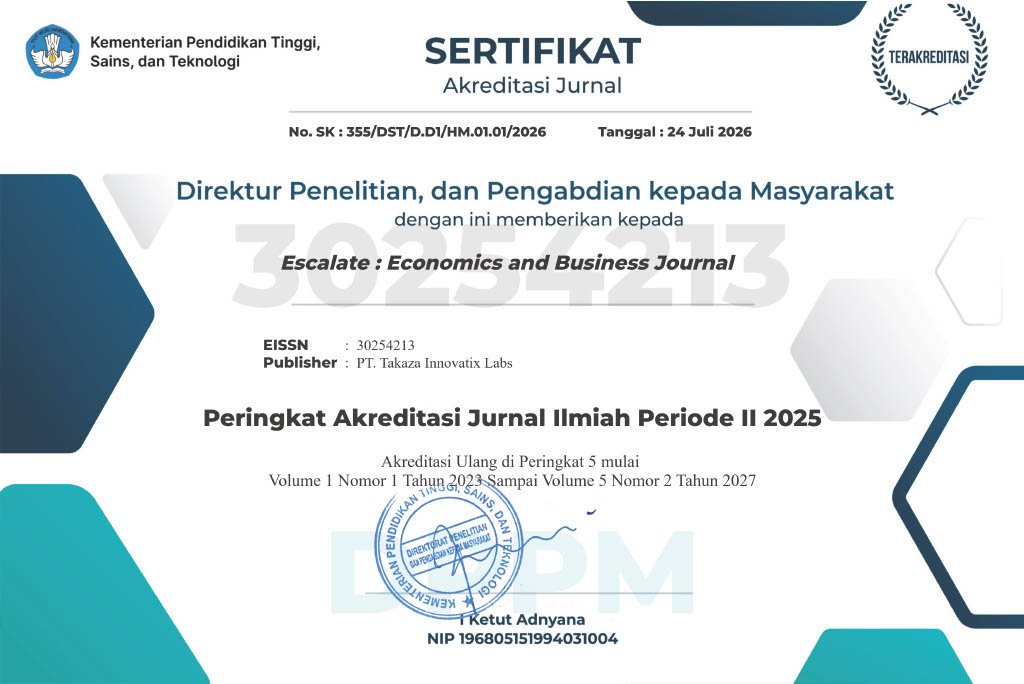
E-ISSN: 3025-4213
Published by Takaza Innovatix Labs Ltd.
Visit Official Journal Website ↗